Hello to all who have followed Teh Portly Dyke here over the last three years.
This post is to let you know that I've moved/consolidated my two blogs -- This is the Thing and Teh Portly Dyke, into one, and will now blog exclusively in one place -- at my new space . . . .
There, you can find all the old posts from TiTT and Portly Dyke, plus all the old comments, and new stuff, too, like archives of my Madwoman At Play video shows.
If you've commented at this blog, you may have to make an initial comment at the new place that I can approve -- once I've approved your first comment, subsequent comments should go through immediately.
Comments here at Teh Portly Dyke are now closed on all posts, but all the old comments are available, and comment threads are open at Madwoman, so if you find something here you want to comment on, simply search the post title at MWaP|Teh Blog, and drop your comment there!
Come on over and join me! I've started the new blog on January 1, 2011 -- 1/1/11, baby!
OK -- so I've kicked off a new feature at my tri-weekly ustream show MadWoman at Play -- it's called "Ask the MadWoman", and will be featured during Sunday evening shows.
The problem is: I need people to ASK me something.
It can be anything -- anything at all -- whimsical, serious, personal, global, whatever.
If you ask it here in comments, I'll probably answer it on the show (no guarantees, just strong probability) -- if you let me know that you want your name included when I read/answer your question on MWaP, I'll include it -- otherwise, I'll keep you anonymous.
If you've been watching my new ustream show (Madwoman at Play), and you're on one of the many email lists that gives notices about the show, you'll know I'm not broadcasting tonight -- but you can view the last show right here! Click the small play button in the control bar if you want to view on this page -- NOT the big button in the screen (which will take you to my ustream recorded video page).
Streaming live video by Ustream If you haven't been keeping up with the show, click the big button to see archived shows on the recorded video page.
Click HERE to find out how to follow the show and get email, facebook, twitter, or myspace announcements about MWaP.
I used to have a hair-dresser who I would allow to do all kinds of weird-ass things with my hair.
She loved me because I wasn't averse to ridiculous experimentation, and every time she started something really wild with me (I sported a leopard-spot crew-cut before anyone even knew what to call it), she would begin by running her hands through my locks and saying: "OK! Here We GO!"
In precisely that spirit, tonight I'm kicking off my new thrice-weekly Ustream show -- called MadWoman At Play.
I have no clear idea what the result will be, but I know what my intention is:
To express myself fully in a way that moves me (and everyone who wants to come along) to the world I want to live in.
I've been talking to Melissa McEwan about this on the phone so long she probably thought I was NEVER going to do it, but -- tonight's the night.
(A note for deaf and hard-of-hearing viewers -- I'm going to be getting captions up as soon as possible after the live broadcasts -- the video above is close-captioned, but Ustream hasn't mastered that yet, so captions and/or transcripts will follow the live broadcasts a few days later, when I post recorded shows on Youtube.)
If you visit the MW@P homepage, you can find links to follow the show on Ustream, Facebook, Twitter, and/or Myspace.
Hey! Come on over tonight and see me being weird-ass!
(If you can't make the live broadcast at 5 pm PDT, you'll still be able to watch the last recorded show until the next live broadcast.)
In the course of discoursing on the web, I've witnessed and participated in many conversations about semantics and language.
I've seen discussions about whether the word "niggardly" is racist or not, whether or not the origin of the phrase"rule of thumb" refers to domestic violence, and whether the term "lame" has entered common usage to the extent that people who have difficulty walking should just stop being offended and shut up about it, already.
Now, I know that the word "niggardly" is not etymologically derived from a racial slur, but so what? If my listener/reader doesn't know this, do I really want to derail from whatever topic it is I'm addressing by pressing that debate, just so I can sound like a Dickens character?
Which leads me to the most complex question on this issue (for me, at least): Why am I choosing the words I'm choosing?
Am I choosing certain words and phrases because I think they will help me establish my own identity?
The choice of the handle PortlyDyke, for example, is rich with reclamation for me, but also serves as a handy auto-filter -- if people are offended or put off by my screen name at first read, I can guess that they're probably going to be offended by a lot of things I say, and if they chuckle upon reading or hearing it (which happens a lot) I figure they're probably going to appreciate my sense of humor.
Am I choosing language that helps me bridge a gap?
As a 53-year-old who interacts with online communities which are often composed of much younger people, I find that I often refrain from using idioms that "date" me. When I find myself communicating with someone who is relatively new to feminist thought, I may not use phrases that are commonly used in Feminism 301 conversations. If I'm talking to my 83-year-old mother about my spiritual views (which is rare, I grant you, but it happens from time to time), I tend to use phrases that are somewhere between her notion of the Big White Guy in the sky and my ideas about a Vast Organizing Consciousness.
Am I choosing idioms because I think they are going to "buy" me some kind of acceptance?
This is a slippery edge for me, really -- because at the same time that I'm dropping some terms that would peg me for an old fogie, I might also slip in some words and phrases so that I can sound "hep", even if I don't use these in my day-to-day speech (and see, that right there is an example of an old-fogie word -- "hep" -- which is a dead giveaway). This behavior, by the way, can go horridly, horridly wrong (like when your Dad tries to sound cool in front of your friends).
Also, in the same moment that I'm searching for words that Mom can relate to, I might be filing off the edges of my own belief system, in the hope that my world-view would be more accepted by my family. Which sucks.
Sadly, these attempts to purchase acceptance inauthentically rarely really work in the long run. An example I'd point to is Rachel Maddow. There are many things about her show that I absolutely adore -- the way she opens interviews with potentially combative people by asking them if she's gotten the fact right in her intro, the general fastidiousness of her civility toward them when debating even the most difficult issues, etc., -- but there is one thing I hate: Her continuing use of the words "lame" and "lame-itude" as an idiom for "bad". I even wrote to her about it (gently, civilly).
At first, I thought my reaction to her use of this term was "just" being offended by the ablism demonstrated (which would have been enough) -- but I realized later that another thing that grated on me was that she seemed to me to be using this able-ist term in order to sound cool. There is just something about the emphasis she uses when she says it that rings to me of the 11th-grader who's trying to get in with the popular kids. It seems out of place in the midst of her usual Rhodes-Scholar presentation, and it jars the hell out of me every single time. I want to say to her: "Rachel, you're the first out news-lesbian headlining her own show on a major network. You're cool enough already."
I think it's important for me to know why I'm speaking or writing as I am. I think it's important for me to be clear about my intention when I communicate.
For me, the only reason to post something like this to a blog is to communicate and connect with other people, with the intention of raising their consciousness (and my own, which happens both during the writing process and subsequent discussion in comments), and I don't think I'm going to be very effective at that if I am leaning on idioms that a) have underlying meaning that I don't support, b) are inserted to somehow buff up my image rather than communicate my point, or c) I already know are likely to offend people that I want to communicate and connect with.
I have found, in every single case where I have used an offensive word or phrase, or undermined my own communication by employing an idiom which was rooted in the language of oppression -- let me repeat -- I have found in every single case that there were other words available.
Other words that not only didn't alienate my intended audience, but which usually spoke my point more eloquently.
To those who would argue that maintaining this level of consciousness about language is an onerous burden laid upon them by the evils of political-correctness, I will simply say:
There are over 200,000 words in the Oxford English Dictionary -- many of them languishing in the linguistic lethargy of left-behind lingo. If you really don't care who you offend, or how much you sabotage your own communication in the process of maintaining your "with it" factor, you might actually sound edgier if you use something like "That's so absolutely inverted" instead of "That's so gay" -- because never forget -- the really cool kids don't repeat the offensive slurs -- they invent them.
For those of you who find that the effort toward clear, responsible communication is a yoke which does not chafe you, remember -- there is no shame in visiting Thesaurus.com.
I find idiomatic speech and shared lexicon endlessly fascinating -- never more so than when I study a sub-culture of which I am a proud member: The Gay.
I can't tell you the number of times I've stumbled on some online conversation where homophobes are moaning about how we nasty Queers have "hijacked" a perfectly nice word that used to mean "happy, merry" (happy, Mary?), and "why can't they just be called what they are -- homosexuals!".
Which is very amusing to me, because the term "homosexual" was coined in the late 1800s, and first used in an English text in 1897 -- at around the same time that queers were reclaiming the word "gay" in reference to themselves ("gay" was originally used idiomatically to indicate anything "immoral", but especially in terms of sexuality and promiscuity -- for example: a "gay house" was a brothel). Gay was used commonly within the community of self-identified homosexuals by the 1920s, and there's evidence that it was used as early as the late 1860s.
So which came first, Teh Homo or Teh Gay?
Doesn't matter, AFAIC -- what matters to me is how people being identified with a word want to be identified. Me? I prefer "queer" as a general term for the community I consider myself a part of, but I've had friends and lovers who hated this term -- they preferred "gay", or "LGBTQ" as a descriptor. My very best friend (my Beloved), doesn't like any of them, and doesn't want her sexuality labeled at all.
*Ahem* I shall henceforth trot myself back over to the focus of this post.
I think it's clear that by now, the word Gay has been reclaimed successfully by the queer community -- so much so, in fact, that it's unlikely that an author writing in English would use it without being aware that various layers of meaning might be read into it.
On the downside, it's been so successfully claimed that it can once again be used as a pejorative by virtue of being associated with queers ("That's so gay.") *sigh*
"Dyke" is another word that's been reclaimed (see Dyke, sub-category Portly), as is "queer", although the re-appropriation of these terms carries a certain level of controversy that is similar to (but, perhaps, milder than) the split in feminist communities over the word "bitch".
I know a number of lesbians who would be absolutely offended if I called them a dyke -- even in private, or in the exclusive company of other lesbians. I also know lesbians who would be offended if I referred to them as "gay women", and gay women who would be put off if I called them lesbians.
So what's a dyke to do?
Well, for one thing, comprehend and respect this fact: It is vitally important that oppressed persons retain the agency to identify themselves.
Labeling a minority, or any oppressed class, is big tool in the oppressor's tool-kit. That's why there is such a vast array of slurs applied to people who are disenfranchised based on their sex, color, race, creed, orientation, disability, national origin, etc..
When a member of a privileged class uses these terms, they are saying, in essence: "I own the culture, and I get to define you." It is an attempt to exercise power, whether conscious or unconscious.
When a member of a non-privileged class re-appropriates the term, they are saying: "No, you do not define me."
Tends to piss them off (the privileged labelers, that is).
Here's a true-story example: I was walking down the street holding hands with my girlfriend, and the guy we'd just passed said (just loud enough for us to hear): "Fucking dykes."
I turned around and said, in my cheeriest voice: "Congratulations, Sir! -- you have correctly identified the dykes -- but I will have to remove points from you for mis-identifying our current activity."
He was absolutely aghast.
I had not only refused to passively accept his right to label me pejoratively -- I had had the audacity to actually confront him for attempting to "power-over" me.
In his mind, the way this was supposed to work was that I would get scared, or drop my girlfriend's hand, or feel ashamed, or Maude knows what -- however he thought it was going to play out, clearly it did not include me engaging him directly and proudly claiming the term he sought to denigrate me with.
So, what does all this have to do with Part 1?
Let's say a person of privilege uses a term or idiom (perhaps with no intent to offend at all) and a member of the non-privileged class says that it is offensive to them, and the privileged speaker responds with something like: "That term has come into common use and isn't offensive anymore".
I believe that they are enforcing their privilege.
I believe that they are reiterating the following message (usually, completely unconsciously):
"I have the power. I own the language. Your experience does not count, and the fact that you are offended is of no consequence, because you have no power."
Which is fine, if you aspire to be a privilege-wielding butt-hole.
Recently, I participated in a conversation about certain words and phrases and when they do (or whether they can) become used as common vernacular to the extent that they lose any derogatory or degrading meaning inherent in their origins.
It isn't particularly important what the exact phrase being discussed was at this point, but it is a subject I see come up frequently, especially on blogs where people are making an effort to use language responsibly, inclusively, and non-oppressively.
So, I'm going to offer up what I use as my general guideline (aka "rule of thumb" -- see more about that in part 3 of this series, arriving in a few days) when thinking about what language I will use when communicating with others, especially on the internet.
I'll start with a wee story: A number of years ago, when I was first studying Hebrew, I would occasionally send an email in Ivrit to a friend in Israel. I was learning formal Hebrew, so to him, I'm sure my emails read as if I was a real stuffed shirt (fortunately, he knows me better than that). He would tease me a bit about my proper language and was infinitely good-natured and supportive when he corrected some of my word choices to a better reflection of day-to-day speech.
One day, though, I sent him an email about Halloween, and I indicated that many children had come to my door "begging for candy". He wrote back and warned me with uncharacteristic sternness that the word I had chosen for "begging" would be offensive to many native Hebrew speakers in this context, even if I was just being hyperbolic about the Trick or Treat traditional threat/demand chant of costumed children on a pagan-esque holiday.
I asked him to explain this to me, and he said that the word would imply, in Israeli culture, a certain level of poverty and powerlessness so abject that it would not be a joking matter, especially when referring to children.
He went on to talk about the complexity of attitudes re: begging and charity in Jewish and Israeli culture, and how using such a word in this context might even subtly indict the community referred to of failing in their responsibility to care for their children.
This experience was very enlightening to me. My friend's explanation took some time -- he had to provide me with history and context in order for me to fully comprehend, as someone outside both the culture and the language, why one word next to "Beg" in my Hebrew dictionary implied wretchedness and cultural failure, and another simply meant "asking emphatically".
Since then, I've used this as a tool for determining whether a commonly-used idiom can be successfully detached from any oppressive history or present-day offensiveness.
This is how I use the tool:
(Note: In this example, I'm going to use a fairly innocuous phrase, rather than something as highly-charged as "that's so gay", or "shuck and jive" or "bitch", but this technique can be applied to pretty much any phrase that some people receive as offensive because it's racist, sexist, homophobic, transphobic, ablist, etc., while other people argue that commonality of use has rendered inert any roots in racism, sexism, homophobia, transphobia, ablism, etc..)
I'm going to use the phrase "Pardon My French".
Let's imagine that I am conversing with a person who is just learning English, has a fairly good word-by-word vocabulary, but who knows nothing about France except that it's a country, and nothing much about the culture of any country in which this idiom is used.
I say: "Damn this fucking pickle jar lid! -- Oh, pardon my French."
And they say, "Hmmm. Why are you wishing to send to hell the lid of a jar? And what do the French have to do with it?"
First of all, I would have to explain to this person what I mean by "damn this ___" (that what I really mean is definition 5 in the OED -- an expression of frustration).
If they ask (and why wouldn't they?) how a word whose first meaning is "be condemned by God to eternal punishment in hell" came to mean that I'm annoyed, there might be conversation about Judeo-Christian attitudes, and why some words which are considered "bad" come into use only in moments of great frustration. I might also need to relate this to any words considered to be "cussing" in the speaker's own language (which might involve the etymology of the word "cuss").
However, let's assume, for the moment, that the listener understands the concept of cursing, but is scrambling to comprehend the Gallic influence on my U.S. potty-mouth.
I would need to explain to this person a least a little bit my culture's historical attitudes and stereotypes about residents of the country of France, who are assumed to be libertine from birth, and why some members of other countries attempt to excuse their "salty" language by claiming that they are just speaking French (and then, of course, I'd have to explain why "salty" language has nothing to do with sodium chloride), and I'd probably need to put in some stuff about why some people in our culture think that using the word "damn" in any context is bad/wrong, and I'd probably touch on why they are likely to hear the word damn on broadcast television at some hours, but never the word "fuck", even though they are both "cussing". Phew!
The point is -- I consider that if I can't explain an idiom without also describing a system of bias or discrimination or oppression that gave rise to it -- the term is fundamentally discriminatory and/or oppressive.
And this is "just" Pardon my French! -- something I doubt most people think of as demonstrating bias (although I think it does) -- and the residents of France are not really all that disenfranchised as a group. Think about how the energy of oppression in these casually-expressed idioms are amplified when they involve groups and individuals who are more deeply other-ized.
You may be breathing an exasperated sigh at this moment and saying to yourself: "Oh PortlyDyke, do I have to always be thinking about every single word and phrase I use?"
No. You don't have to do anything.
However, in the text-saturated environment of the blogosphere, words and phrases are often the only tools we have -- and ostensibly, we are here to use those words and phrases to communicate to, and connect with, other people.
So, if there are words and phrases that I use, but haven't actually thought about -- idioms that may be so common that I don't have a clue about their etymology, but which I find are undeniably rooted in discrimination and oppression when I use the "explain it to a non-native speaker" exercise above (such as the phrase: "I got gypped" -- a slur against Romani people that I'm often surprised people don't know about) -- if I continue to use these words and people are offended by them and I say: "Hey, it's common usage! I didn't mean it like that" . . .
Well, if I do that, I think that what I'm really saying is:
"I want to use these phrases because they are an easy short-hand for me, and/or they make me sound hep, or edgy, or current -- and I want that more than I want to effectively communicate and connect with you."
Which, when I put it like that, sounds really shitty of me.
OK, so Ms. Sovereign McHammerson is not much of a hunter (which we are happy about, as one of our household pleasures is bird-watching). Turns out being a cat so blazingly white that photographers are hard-pressed to even snap you in correct exposure is also not the greatest advantage as a predator (unless we move to Antarctica).
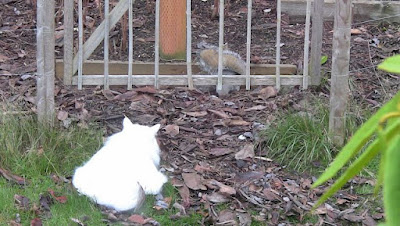
So, a couple of weeks ago, I'm sitting on the side porch, and see this, out by our raspberry patch:
You might not be able to tell from the photo, but Sovereign and the squirrel are like, nine inches apart. (It was hard for me to get a decent shot, because every time I came out, the squirrel would run away, but then would come right back, within inches of Sovereign, turn it's back on her, casually eat some of the sunflower seeds that had fallen from the bird-feeder, twitch its tail in her face, etc.)
This went on for a number of days. Sovereign showed interest, but no real hunting behavior -- usually she was in Kitteh Meatloaf position.
So, about the third time I see it, I decide to get the camcorder and shoot a little "Lions and Lambs Why Can't We All Just Get Along?" video, when this happened: (TW video below may increase adrenal activity in wild-life-lovers)
So, now I'm thinking that it will never be the same between them -- the squirrel has now learned that this big white fluff-ball would like to chow some sunflower-stuffed Sciurus griseus.
But no. The next day, I look out the kitchen window and see this:
Let me enhance that for you.
OK, bad photo, so I go out to get a better angle, and once again -- the squirrel runs away from me, not the cat.
I honestly believe they are just playing. Or the squirrel is messing with her mind. Or both.
So, in mid-September, this kitty showed up in our yard.
At first, we figured someone new had moved into the neighborhood, and that she was just checking out the new neighbors, but she didn't seem to be going home.
We called the shelters, the vets, and checked all the "lost pet" ads we could find for our area. We even took out a "found pet" ad in the local newspaper, because we were just certain-sure that someone must be looking for this beautiful cat. We fed her and let her inside when she wanted to come in (she's quite the outdoorsy type, but was soon joining us on the bed every night), and we asked around to friends that we knew were looking for a new cat, because we really weren't sure we were ready for a new cat (Little passed away less than a year ago) -- plus we weren't really sure this kitty was "ours" (know what I mean?).
So, for about six weeks, we just hung around together. No one called from the shelter, or the vets, or the paper -- and we . . . . started falling in love. Because really?
How could we not? I mean -- really . . .
We stopped calling her just "White Kitty", and started calling her "Sovereign" (also "Hammy McHammerson", because she seems to vacillate between standing on her enormous gravitas and acting like a complete goofball).
We formally adopted her on Winter Solstice, and as of January 14, 2010, she is officially land-lord approved (we had a pet deposit that was quite specific about the pet it covered, but she is now formally covered by the Pet Rider in our lease).
So we are very glad to welcome Ms. Sovereign Please-Carry-Me-Around-the-House-in-A-Sling & Give-Me-A-Greenie to our briefly catless household.
I will be following up with some film of Hammy McHammerson and the Squirrel in a few days.
This is a companion piece to my infamous "How to Fuck Up" post -- because, just as surely as you will fuck up some day, it's certain that someone you know and interact with is likely to fuck up, too.
And really, since you're as likely to be on the "fuckup-ee" end of the fuck-up as you are to be on the "fuckup-er" end, it might be a good idea to get some practice accepting those apologies in the way you'd like others to accept yours. Dontcha think? Or dontcha?
I'm assuming that you've already read the other post, so you know all about what I consider a "real" apology. In this exercise, I'm going to assume that you've actually received a real apology (because if you haven't, then you haven't been really been apologized to, so there's nothing for you to accept).
(Note: This post is focused mostly on how accepting an apology bears on relationships with people and groups you actually care about having relationship with, but it may be more globally applicable -- I just haven't taken it there.)
There are two basic scenarios that I've experienced once I've received a real apology:
Scenario 1
FuckUp-Er apologizes to me.
I feel a rush of relaxation move through me, and usually, whatever stony guard I've built up during the fucked-up interaction seems to melt away -- usually immediately and for good.
The slate feels clear and clean.
Scenario 2
FuckUp-Er apologizes to me.
I do not feel that rush of relaxation.
In fact, sometimes, I feel even more irritated.
When Scenario #2 occurs, I find that the first thing I think is something like: "They didn't really apologize."
If I go back and check, though, and find that they did acknowledge, apologize, and amend, and I think they really did apologize -- I usually find that I have other stuff going on internally -- like a) I don't think they are sincere, or b) I don't trust that they are actually going to do something different in the future, or c) I find that their apology seems not to cover the scope of what I'm pissed about
The fact is, if any of these things are true, I think the person who really has a problem here is me.
Here's why:
Let's say either a) I don't think the apology is sincere or b) I don't trust that they are actually going to do something different in the future.
Essentially, I am saying that the person is apologizing in bad faith -- and if I'm saying that, what does it say about the fact that I'm continuing to interact with that person?
I'm essentially admitting that I don't trust them -- so I think I need to dig into that and see what the source of my mistrust is.
Is there something that I've actually witnessed in this particular person's behavior (toward me or toward someone else) that makes me think that they don't mean what they say?
If I find that I believe that this individual person is unworthy of my trust, based on actually observations I've made of them -- then what the hell am I doing continuing to partner with them/work for them/read their blog/pretend that we're friends?
When I continue such interactions, knowing that I don't trust that person, I think that's my bad -- and it's likely that I'm going to feel pretty peevish about betraying myself in this way (hence, my escalating irritation).
Now, what if I examine the observations I've made of this particular person and discover that I don't think it's their individual actions that I don't trust? What if I find out that I'm defended and cautious because I've been screwed in the past by people who might be like them in some way?
Well, again, I think that's my problem.
I'm not saying that I'm "bad" for feeling cautious (for example, if I'm cautious around straight people in general). I'm not even saying that it's unwise -- Maude knows I've had my share of experiences with straight friends who make witless remarks that demonstrate their straight privilege.
I'm saying that the caution belongs to me -- it's mine.
It's quite possible that a situation could arise where a straight ally might make a gaff, then apologize quickly and quite sincerely, and my past experience could harden me to it -- but I try to be very aware when I hear my internal thought-process running along the lines of "Straight people -- you can't trust 'em!" -- because this is exactly the kind of broad-brush bias that I don't want to be painted with as a queer.
These days, if I find myself in a situation where I feel particularly surprised and shocked at the speech or action of someone I previously considered an ally, I try first to assume "friendly intent", and I'll go a long way to get to the bottom of what's going on if the other person's amenable to it, because I'm currently more interested in seeing if people will transform than deciding that they're all out to get me.
So, what happens if I actually do trust them, but c) I find that their apology seems not to cover the scope of what I'm pissed about?
If I find myself saying/writing things in the course of attempting to accept an apology like:
"Yes, you apologized, but there was this other time that you did (x/y/z) . . . ", then the truth is, I'm dealing with backlog.
Nasty, erosive, relationship-destroying backlog -- times where I didn't speak up when something bugged me, and then didn't speak up again, and again, and again -- and now there's this morass of feelings that I've got -- and yes, for sure, this one little apology for the thing we're dealing with now is not going to heal all that.
And guess what?
Once again, I think that's really my problem. I didn't speak up. I let things slide. The other person has absolutely no control over what I choose to do, so how in the world can they be responsible for my pent-up, stewing, brewing anger?
Yes -- "anger" (maybe even rage) -- not "mad". I think "mad" is a real emotion that happens in the moment, and that "anger" is the result of suppressing mad.
Mad is in the present. Mad is: "You're whistling, and it's bugging me."
Anger is: "You whistled yesterday, and the day before that, and NOW YOU'RE WHISTLING AGAIN!!!!!"
Anger is in the past.
Don't get me wrong -- I have no problem with feeling "mad", or even being "angry" -- I've just found it incredibly helpful to know what I'm actually feeling mad or being angry about.
See, the problem with anger backlog is that, once you have it, you're not really mad "at" that person anymore -- you're mad "at" yourself -- for not speaking up, for not putting a stop to it -- so it will not matter how many times they apologize to you, or in what manner -- because they're not who you're mad "at"/angry "with".
Here, Let Us Pause for A Brief Explanatory Break:
The scare-quotes around "at" (above) exist because I actually think it's sloppy emotional communication to say I'm mad "at" someone.
My emotion is entirely internal -- yes, it might have been stimulated by something someone else did, but the feeling still belongs to me.
If I direct my mad "at" someone -- try to use that energy to make them "wrong" and "bad" -- rather than directing toward action to rectify the speech, action, or event that's stimulating this essential response in me, my experience is usually that the "mad" just builds up, turns to anger, and toxifies me.
I believe that the purpose of "mad" is to motivate us to align things that are out of alignment in ourselves, our relationships, and the world. When mad is used correctly, it fuels change.
Mad can actually feel good, sometimes. It's a highly energetic emotion -- your blood gets pumping, your get off your ass and start talking, or writing, or taking action, or yelling -- think about the sensation of "Righteous Wrath" (which is probably actually "anger" anyway -- but I won't go off on that right now. I mean, I could -- but I won't).
My experience of "Righteous Wrath" is that it nearly always arises when I've been holding back/not speaking up/biting my tongue. I wait until the person does the thing that I've been mad about just one more time, in a way that I can absolutely, positively point to (usually with a trembling, pontifical index finger) and say "There! You see? You did it!" (And inside, a nasty little voice says: "Ah-ha! I've got them now!!!!!", and I ride, ride, ride the energy of my Righteous Wrath.)
That can be addictive, that energy -- the Red Bull of the emotional realm -- but let's be honest about how nutritious a steady diet of it is going to be for any relationship you actually want to keep.
/As-It-Turns-Out Not-So-Brief Explanatory Break
So, when you are presented with an apology that you think is genuine -- which includes the four As -- here's what to do:
If you feel that Scenario #1 rush of relaxation, rejoice in that fact that something in the world has gone awry and been brought back to balance. Tell the person who apologized that you accept their apology, and that you're ready to go forward with them to a new moment.
If, instead, you find that you experience symptoms of Scenario #2:
Take a deep breath.
Tell the person that you really would like to accept their apology, but that something doesn't feel quite right to you. If you need it, ask them for a little time to discover what's going on for you.
Examine whether you trust this person or not, based on your experience of them. Perhaps more importantly -- ask yourself if you want to trust them.
If you don't trust them, stop having these interactions. You don't trust them. If you keep relating to them, I see (with my prodigious psychic powers) . . . . a train-wreck in your future.
If you do trust the individual, but still feel unsettled, ask yourself whether this person belongs to a class of people that you generically mistrust, and think about whether/how that generic mistrust may be affecting you and your relationship with this individual.
If trusting their sincerity and good will about future action is not the issue, but you find that you have backlog with them, accept their apology for this occurrence graciously, and then -- clean your shit up! if you want to have a relationship with them. Do this separately from the apology acceptance. Start with something like this: "When we were talking about what happened, I really felt and accepted your apology for what you did, but I noticed I had some lingering feelings. I realized that I haven't been honest with you -- I've been holding some shit back about things that have happened in the past. I'm sincerely sorry about that. I want to clear them up now."
Unless I ascend in the next five minutes, it's pretty likely I may make another mistake in this lifetime, or interact with someone who will make a mistake in this lifetime.
I like knowing how we might find our way back to grace.
For those of you who are curious -- yes, I have continued to send emails to my representatives about investigating torture. One of them actually responded directly, one of them invited me to a fundraiser.
There has been progress, though, with Holder's move toward inquiry. I'll keep writing.
From time to time over the years, my Beloved and I have engaged in what we call our "Daily Creative Bits" -- where we do just a daily snippet of writing or art every day and email it to one another.
It's an exercise that isn't about making perfect creations, but rather, about getting the creative juice flowing.
In recent weeks, we've been delighted to be joined in this daily venture by our dear friend (and now, land-mate). I've really been enjoying the exponential energy of it, as I receive their daily creative bits, and produce my own.
Here's my bit from yesterday -- a miracle of brevity for long-winded me.
In the past couple of months, I've been rediscovering the importance of laughter in my life -- and that process has been greatly helped along by a dear friend who loves to laugh as much as I do.
We've been watching this youtube video over and over, because it makes us laugh -- every single time.
(note: if you're not familiar with the character of Stuart and his mom Doreen from Mad TV, this may not seem as funny to you as it does to us -- I don't know why, but watching Mo Collins crack up is way funnier to me than the actual sketches where she doesn't):
So, I haven't blogged at all for nearly two months.
Yes, I have been busy in "real life" -- building someone a website, making a couple of new videos for people, painting the exterior of the house, working on a novel, putting up a new online class, adjusting to new community members, and spending more time in the Summer air.
But none of those things are really the reason why I haven't been blogging.
The simple truth is, I've been trying to figure out whether I want to keep blogging at all.
A couple of months ago, I was involved in one of those inter-blog incidents that arise now and then. I found myself the focus of an online discussion at a blog that I had never read before -- a blog that I might never have read, had I not become a subject of discussion there, and had someone not "kindly" informed me of this by dropping a link to the thread in a discussion at a blog I actually do read.
Being the curious type, I went over and had a look.
All I can say is -- good thing I'm not a cat.
The statements that I was a whack-job and a scam-artist didn't really bug me that much, especially since they (mostly) came from people I don't know even remotely -- in my line of work, I've heard this stuff before, and after a lifetime of being called "unnatural", "pervert", "sinner", "damned", and worse -- whack-job and scam-artist just don't nearly pack the punch you might imagine.
The participation of people in the thread who I did know, but who didn't seem willing to confront some of the nastier stuff said about me -- some of whom I'd had personal contact with, and a couple of whom I'd actually provided with some pretty involved support in the past -- did bother me a little.
Still, I did what I usually do -- I tried to assume the best and figured that the people who I had thought liked/trusted me, but who seemed fine with standing by as I took a hiding might be either a) just getting caught up in the sturm-und-drang of it all, or b) be scared that if they did speak up, they would become a target of the same type of vitriol that was hurtling in my direction (which seems a rational concern in the circumstances). Once again, my experience as a queer stood me in good stead -- I'm kind of used to people not standing up for me -- even people who say they know and love me.
I opted to just observe my own responses, take care of myself, and generally didn't get my knickers in a twist -- I figured there would be about of week of shit flying in my direction, and then something else shiny would draw the attention of folks who like a good internet rumble.
Since I worked my masochism out a long time ago, I chose to simply stop reading the thread, as I couldn't imagine what possible good it might do me to allow it to occupy more space in my brain.
But then, it followed me "home".
Home to my website (you know -- the one that is associated with my livelihood?). I started getting all these weird, off-topic comments at my other blog and the forums that I maintain, and a raft of bogus registrations from people with handles like "SoYouThinkYourPsychic" and "stoptehscamming".
*sigh*
I did what all good web managers do -- I went into the logs to find out where this stuff was coming from so that I could block IPs if I needed to (my website generally nets about 900 unique visitors each month -- 90% of which are generated from the email list that folks have joined after participating with me in person -- so I was wondering where an extra 400 unique visitors had come from in a week).
Turns out, someone had linked my personal bio at my site in the "conversation" at the blog-i-might-never-have-known-about-but-for-a-"kindly"-link.
My bio -- where I get all exposed and vulnerable and shit about my personal history, and the weird-ass job that I do, and where I come from, and who I am, and who I am trying to become.
My bio at my home website -- where my phone number and address are intentionally accessible, so that people who are interested in knowing more about what I do could find me if they wanted to.
So -- you may think that this is a post about this terrible thing that happened to me when people tried to harass and bully me on the internet.
But it's not.
This is a post about about the basic inequity that can arise between people who are willing to be visible, authentic, and vulnerable -- online and off -- and people who aren't.
I was surprised that I didn't freak out when all this bizarre traffic hit my home site, from people who seemed to have only a couple of things in mind -- 1) to attempt to freak me out and 2) to "make" me feel vulnerable. There was a time in my life when it would have scared the shit out of me, and led to sleepless nights wondering if any of those people were vindictive or insane enough to take their seeming enmity towards me into the meat-world.
I think it didn't freak me out precisely because I'd already been moving in the direction of becoming more intentionally vulnerable and revealed.
I knew, last year, that abandoning my cloak of psuedonymity as Teh Portly Dyke and identifying myself as a real-life person with a real-life profession might result in rejection from some, derision from others, and outright hostility from a few -- but that was a risk that seemed miniscule when balanced against what it would cost me to continue to live my life as a disjointed, dis-integrated being.
So, I opted to come out -- again.
It was heartening to me that when I did this, there was nothing in my blog history as Teh Portly Dyke that I found I wanted to hide or take back as Carol Steinel. It was also heartening (and unanticipated) that my revelations seemed to give others the courage to be more forthright about beliefs and philosophies that they held, but rarely revealed, because they worried that people would brand them as "crazy".
In the months that have followed the conversation-about-me-that-I-wasn't-a-part-of, though -- as the bogus registrations and non-sequiter comments gathered into a big stinky cloud of inconvenient web-management and then slowly subsided -- I gained a deeper understanding of my original motivations in taking on the psuedonym of which I've now become fond.
I realized that, when someone criticizes your anonymous online persona, you think that you can pretend they aren't really criticizing you -- you think you have created something that they can throw stones at, and that you will be able to stand aside from that target and chuckle as you watch the card-board cut-out fall over backwards.
Except that you can't, really.
You still feel it somehow -- at least that was my experience -- and at least partly why I chose to come out as myself, finally -- because the stones that landed on the noggin of Teh Portly Dyke (even before I vulnerabalized myself) actually did give Carol Steinel a headache from time to time.
Conversely, I found that when people praised Teh Portly Dyke, Carol Steinel didn't really feel the appropriate glow -- because there was always that little voice piping up -- "Well, if they knew who you really were, and what you really did, they wouldn't praise you".
The worst of both worlds, really.
But I digress.
Here are some of my current problems with what I call the internet's "Twilight Tendencies":
If I'm using the internet as a tool for revelation, connection, and evolution, and you're using the internet as a tool for entertainment, distraction, and simple maintenance of the status quo, it's likely that our interactions on the internet will reflect the natural tension that can exist between those goals.
My intention is probably going to lead me to an increasing desire to make myself vulnerable and identifiable, and to seek to know more about you (how else can I truly connect?), whereas your intention is more likely to lead you to remain anonymous (because, after all, the beauty of passive entertainment is that you aren't really "in" the game -- your avatar is), and perhaps, one of the ways you might entertain yourself is by poking at the tender spots I've exposed.
I actually don't even have a judgment about that -- a person who chooses to remain anonymous on the web usually does so because they take what is, to them, a "realistic" and cautious view of the online world. From their perspective, my choice to risk being identified may be foolish at best and "asking for it" at worst.
I can understand that because I've been there. The rationalizations I made to myself for remaining anonymous at TPD originally didn't run along the lines that people who opted to be identified were stupid or deserving of harassment, but there was at least a dash of a desire to remain above the fray -- to speak without a certain level of personal accountability, and to experiment with the invention of an online presence in terms of how closely I wanted it to reflect my real-world self.
As time went on, though -- as online friendships transformed from in-jokes at the Virtual Pub to private chats of the LOL-OMFG-variety to private chats of the "What would feel supportive to you right now? How can I help?"-variety to face-to-face conversations on Skype or landline phone calls -- I re-affirmed to myself that the dynamics of internet relationships are influenced and defined by a couple of the same rules that real-life relationships are:
1) There can be no real intimacy without revelation of the self, and
2) Variances in vulnerability-levels in relationship can leave an open door to abuse of power.
One of the things that always bugged me about traditional therapist/client relationships is that #2 up there -- the therapist gets to know the deepest darkest secrets of the client (they have to, in order to be effective, really), but the client, by design and intent, knows virtually nothing about the therapist's inner life.
When used benignly and ethically, this can be a great format for the client -- they don't have to worry about the therapist's sensitivities, thoughts, or feelings -- in fact, therapists are trained to go to great lengths to prevent the client from knowing them -- so that the client can focus on themselves and their own process. They can fucking scream at the therapist and the therapist is not supposed to take it personally.
Of course, if you've ever been in the therapist's role, you'll know, of course, that there is actually a human being in there -- a human being who does respond and react to the client. Sit through a debriefing with a therapist and their supervisor or support team, and it's evident that the well-trained exterior that most show in their office demeanor is very different from what's going on inside.
I've always had questions about the value of a system which requires the de-humanization of one person in order to facilitate the re-humanization of another.
And this lopsided vulnerability is fraught with danger if the therapist is not ethical -- they can manipulate the client very easily if they choose to, knowing precisely what cues might trigger them into unconscious response, and what desires and fears might be used as levers on them.
Differing levels of vulnerability are problematic in less formal, role-based relationships, too -- think of a couple where one person is frank and forthcoming, while the other person is closed and contained. (For some reason, these two people always seem to end up together, too -- at least for a while.)
The forthcoming member of the couple usually sees the other's containment as a sign of distrust, or as something withheld from them. They often attempt to ferret it out of their more closed companion.
The contained member usually sees the other's attempt to "get in" as a violation of their sovereignty, and often retreats further.
I'm the forthcoming type. Which you probably already know.
In a sense, my choice to blog at all was an expression of that outward-going nature -- I wanted to bring more of myself to the world -- but that's become problematic for me in the Half-In/Half-Out world of the internet.
I do want to share myself with the world. I have thoughts that want more room than the kiddie-pool of my brain.
However, I have no desire to swim with sharks.
Sometimes I wish that there were two internets -- one reserved for the Tron-ists, and one for the Space Paranoids
Adherants of Tronism could use their internet as an ocean of potential connectivity beyond their geographical locale -- a place for them to walk in a virtual body that is a direct extension of their physical form, and that is more than just an amusing game. They would realize that metaphorically crashing your light-cycle online could be every bit as painful or deadly as it would be in meat-world, and that bits and bytes arranged into words could actually reach through the screen and have effect on the User behind it.
And the Space Paranoids could continue to "play" their version of the internet. They could remain safely dissociated from their avatars, and could act out all sorts of scenarios and behaviors that they would never, ever consider in real life. They could snark away and scream words that they would never speak to another person face-to-face, and leave bags of burning dog-shit on each other's virtual porches, secure in the knowledge that every IP connection was an anonymous proxy, and no finger-print or DNA sample could identify them.
The problem for me at this moment is that the Tronists and the Space Paranoids are all shook up in the same bag.
As a result, there are places on the internet to which I do not ever venture -- comment threads at YouTube are about the strongest online toxic that I'm willing to expose my psyche to (and that, only in very measured doses).
I'm sure that there probably are people in the real world who spend the majority of their lifetime-word-allotment screaming obscenities at others in person -- but I've created a life where I choose not interact with them, so why would I intentionally wade into the online equivalent of their living room?
And I guess this brings me to my basic dillema about blogging as myself in an environment where others who choose to remain hidden can drop bags of virtual dog-shit at my door:
Why would I invite those people into my living room? Or even tell them where I live, much less invite them to view the contents of my fucking head?
I have no control over the actions and choices of others. This I know.
I know this, too: The vast majority of people who read my blog have treated me honorably, respectfully, and connectively in comments and emails -- and, as far as I know, the way they've treated with me "to my face" matches the way they've treated me "behind my back".
I kind of hate to admit it, but . . . . those burning bags of dog-shit?
While they didn't "scare" me -- they definitely brought up a desire in me to just duck my head and get out of the line of fire for a while -- to shut up and stop being the target of some anonymous person's/people's inexplicable desire to let me know how much they disapproved of me.
I feel sad as I type that, because I think that this is often why people stop speaking up and stop showing up -- it's not necessarily that they're scared -- maybe they're just tired.
I know that's how I felt during the whole thing -- tired -- as if everything I'd ever blogged that had been helpful or insightful or forward-moving -- had suddenly been vaporized -- so fuck it -- why keep blogging?
Which pisses me right off, now that I tune into it.
Am I going to let a bunch of Space Paranoids wear me down?
Hell, no.
I'm going to recommit to what I believe in: This technology -- the internet -- has massive potential as an instrument of revelation, connection, and evolution.
I'm going to recommit to what I believe in: Truth -- not "the" truth -- but revelation of personal truth -- is a profoundly curative energy.
I'm going to recommit to what I believe in: If I don't bring my voice -- if I don't bring my self -- to the world -- I have willfully forfeited my right to be an agent of transformation in the world.
This year, everyone gets to keep their clothes on (if they want to).
This coming Sunday, June 21st, 2009, I turn 53 — and I’m having a party — a musical party — and I thought I'd put my invite out there, so that you can celebrate with me in spirit, if not in the flesh.
The text of my birthday invite is below.
This year, when pondering what to “do” for my birthday, I was advised to do something I’d never done before — so here’s my plan:
I’ve been wanting to have more live music in my life. There was a time when live music (both playing and listening/dance to) was a huge part of my life, and I miss it.
I’m having a live music party on Sunday. A very intentional live music party — and I’m going to do what I can to help the attendees align with my intention, so that I can have the best chance of getting what I want out of it.
Here’s the roster for festivities:
11 am – Guidance Wander My Beloved will lead a “guidance wander” for anyone who wants to come along, from 11 - 11:30 AM. A Guided Wander is a walk where you let the Universe lead you on the path — you start without a destination and allow the signs and sygils take you from point to point on the way. It’s a ton of fun, and I think it will be a good start for a party where the whole idea is to be in the moment and let the music lead you. If you want to go on the guidance wander with us, please arrive no later than 11:00 am — cause we’ll be taking off then and God knows where we’ll be!
12 pm - 3 pm – Music PartyThe front two rooms of our house will be set up as a live music hall. There will be some spare instruments (we have several guitars, drums, a synthesizer, piano, tambourine, shakers, etc.) — but bring your own if you have them.
Here are the “rules” for the party:
Don’t worry if you don’t have an instrument.There will be an area where there are instruments that are available for anyone to play — if you bring your personal instruments and don’t want to share them (which I completely understand), don’t place them in this area (which will be marked).
Any instrument that is not in this area should be considered someone’s personal instrument — please don’t pick it up, play it, or even touch it without their specific permission.
The front two rooms of our house will be dedicated to music. If you want to have a conversation with someone else at the party, please take this out to the yard or into the kitchen, rather than carrying it on in the hall while music is being made. In the music hall, incidental verbal interactions such as “an-a-one-and-a-two”, “let’s try that in the key of G”, and “Here’s a good one” will be welcome.
Leave your ego and your judgments at the door (especially judgments you may have about yourself “I have a crappy voice”, or “I suck at playing guitar”). Refrain from “taking stage” and performing a personal concert — the point of this gathering is to have people make live music together — not for any individual to give a house concert. Expect that any song/music you start may end up being a group effort, and don’t get in a snit if someone else fires up a harmonica in the middle of your classical piece.
Join in. Yeah, you may not think of yourself as a musician, but that could end on Solstice, 2009, you know? Sing, shake a tambourine or maraca, pound on the drum kit in the synth, dance, listen — stretch your edges.
You may be recorded.I’m going to have the four track deck recording during the party, but it’ll be unobtrusive, and purely for my own enjoyment.
I reserve the right to throw everybody out at 3 pm, although I may not — just depends on how I feel — it’s my birthday, after all.
There will be tip jar out — proceeds will go to me — it’s my birthday, after all.
There will be potluck snack table up — it’s potluck — if you’re going to snack, please also bring a snack to share.
This party is strictly bring your own beverage. Alcohol is welcome, but mindless drunkeness is not (mindful and intentional intoxication to spur you on to heights of musical genius is welcome). If you want something to drink, bring it. I say this nearly every time I have a party, but people inevitably show up and ask: “Can I have one of your beers?” This year, I will be saying “No” in the nicest way, and pointing them down the street to Aldrich‘s, where there is a wide selection of excellent brewsky.
Come absolutely, positivelyfragrance free– if you don’t, I’ll probably ask you to leave, even if that feels embarrassing and awkward for either or both of us.
If you bring a friend that I don’t know, show them these rules before you bring them, and ask them to come only if they want to join in this intention:
The intention of the party is to celebrate and kick-off my 54th year on the planet by making music together that is dedicated to creative, enjoyable connection — and having fun while doing it.
Them’s the rules — if I sound like an old cranky codger, well, I’ve discovered that if I get the boundaries out of the way first, I tend to weed out the people who don’t want to play nice — heh, heh.
Seriously, it’s been my experience that clearly defining the container usually gives us a better shot at cooking up something lovely inside it.
If you want to join in long-distance — play or sing or dance on June 21st — and think of me.
(Oh, and a note: In the past five years, I’ve usually been all “I want your presence, not your presents” — but fuck it — this year, I want some presents. If you want to get me something, drop a tip in the tip jar at the party — or leave something via the donation button up at the top of the page, or check out my Amazon wish-list.)
Here's my weekly letter to congress-critters and President Obama -- feel free to cut and paste at will in sending your thoughts to your own reps.
Dear [Name]:
I am writing you again to request that you do everything within your power to investigate and bring to justice those who have violated US law and UN Conventions co-signed by the United States by perpetrating torture.
This week, the ACLU obtained newly released detainee statements which provide more evidence of torture programs -- and more evidence that they were as ineffective as they were inhumane.
As this evidence unfolds, the last pitiful refuge of excuse for this horrifying activity (performed in my name as a US citizen) -- that this was done for our protection in some kind of "ticking time bomb" situation -- falls apart completely.
It is not a surprise that these techniques are not effective -- the Pentagon was warned of this as early as 2002, and a host of experts in the field of interrogation techniques have clearly stated that the use of torture and inhumane/abusive techniques result in "false and misleading information".
In other words, the use of these techniques not only did not keep us safe -- it is most likely and logical that they have actually heightened the danger to our nation.
In order for us to be a nation governed by the rule of law, those who have broken the law must be brought to justice -- even if there are other pressing things to attend to such as health care, or the economy -- because the rule of law is the anchor of this nation.
What will it profit us if we get our economy fixed, or health care secured for our citizens, if we know that we live in a country where torture was performed, and is now condoned by our silence? What will it profit us if we move forward into some shining new day for our nation, if those who have broken the law and gotten away with it are in our midst?
I urge you, again, to investigate and seek prosecution for those who have broken the laws of this country and violated the UN Convention Against Torture to which this country is a signatory. I urge you to this action as a citizen, but most importantly, as a human being.
Thank you for your time in reading this. I welcome and await your response.
I started to answer over there, but you know how I can go on -- when my response started squishing out the edges of the comment box, I thought it better to address it here at home (you may want to click through to read the question for full context, because it's pretty long, too). My summary of the question, though (and I may not have got it right -- be sure to tell me if that's so, swedishfisherman!) is this: What do I think and how do I feel about the use of the word "psychic", my choice to self-identify as such, and the way that some people use it as dismissive or pejorative.
Here's my response:
I don't generally find an honest question offensive, and I don't find anything about your question offensive at all. In fact, I find it a very engaging question and it's stimulated a lot of thought for me.
RE: The term "psychic". I don't particularly like that term, but it is a handy shorthand to communicate to people a general sense of what to expect when working with me or attending one of my events. It doesn't fully encompass for me everything that I think I'm doing, but explaining that would take several pages -- plus it keeps evolving.
One reason I don't like the phrase "I am a psychic" all that much is that I believe that everyone is "psychic", in the sense that I think that they have the ability to receive information that is clearly not being transmitted in physical 3-d -- whether they use that ability consciously or not. I train people (who want that kind of training) to develop those abilities, and I've never met a person in the course of that training who "couldn't" access others levels of perception, once they started exercising them.
Another reason I'm not fond of the phrase is because of the associations and assumptions which exist for some people, but I recognize that those are outside any realm of my control. (I think that's true of anything that exists in someone else's head, btw.)
My experience has been that most of those who eye-roll over the term psychic probably do so because of a broader set of beliefs and understandings that they hold which doesn't include belief in anything "supernatural" (another term I dislike, but will use here as a short-hand, as that's usually how people who hold these views express it when they talk to me about it). I respect each person's right to their particular personal beliefs and word-views, though, so this doesn't bother me at all.
I think that other people may actually believe that some things exist outside the purely physical perception of reality, but they may have had experiences with professional psychic practitioners that were damaging to them or made fraudulent claims (and I know full well that those kinds of practitioners exist). While I think that's unfortunate, and that some practitioners give the term"psychic" a bad name, I also think that people should listen to their own guidance over anyone else's, so if the very mention of the word gives them the heeby-geebies and they have the impulse to back away or disconnect, I encourage them to do so, rather than to override their own knowing -- so this doesn't bother me either.
In terms of using this word to refer to msyelf, I think of the intuitive abilities that I use in my work not as a "gift", but rather a developed skill-set. Someone may really like woodworking, and even excel at it, but not call themselves "a carpenter". I refer to myself as "a psychic" because I do this work in the world, not just for my own enjoyment (and there was a long time when exercising my intuitive abilities was more of a hobby for me).
My experience has been that most people who are drawn to the kind of work I do don't have usually have a particularly negative connection with the term "psychic" (even some who have had bad experiences with particular practitioners) -- in fact, they seem to be drawn to it -- so I rarely run into blanket dismissal or pejorative use of the word in my work-life. It is usually only when I interface with others outside my work-life and people ask "what do you do?" that I encounter these types of responses.
When that happens (and I tell them), some people simply say: "I don't believe in any of that stuff, but you seem a nice person. Let's talk about gardening." Others may decide on the spot that everything I have said up to that point and everything I might say in the future is now placed in doubt, because my belief in something beyond the purely physical means that I am certifiably crazy.
If I found anything offensive in the comment you mentioned (the one that led you to my coming out post), it is not that this person identified me as a psychic (I identify myself that way -- why would that be offensive to me?) -- but that s/he did so in a way that used my vulnerability in revealing that self-identification as a soft spot in which to poke me, in a context that had nothing to do with my profession. It was clearly a jab (that's not my interpretation alone -- the commenter emailed me after the event to apologize personally to me, and specifically characterized it as "a jab" and "mean-spirited").
My perception is that, when people use this term in a dismissive way (especially in a context outside a discussion of me or my work), it is usually in an attempt (conscious or unconscious) to discredit the other things I might be saying, or even an entire group I might be associated with. ("Well, what can you expect? They hang out with PortlyDyke, and she thinks she's psychic. *eyeroll*)
That second part is a concern for me -- I "came out" in that post with full understanding that some people would dismiss me because of it. That was a risk I was willing to take, but it is a concern to me that others might be similarly dismissed simply because they choose to be associated with me.
Because of this concern, when I decided to come out at Shakesville in the post where your question appeared, I discussed it with Melissa first and told her that I would understand completely if she didn't want me to post it there, or even if she didn't want me to continue as a contributor if I posted it here at my home blog (because a lot of Shakers read me here as well). She, in her usual embracing manner said I was welcome at Shakesville as the person I really am.
In fact, when Melissa McEwan initially invited me to become a contributor (I had only had contact with her as a frequent, but psuedonymous commenter up to that time), I told her what I did for a living before I accepted, and told her: "I wanted to come clean with you about all of this before we continued in confirming your invitation. I won't be at all offended or disturbed if this information is a "deal-killer" for you in terms of the invitation." I felt that it was only fair for me to let her know what she might end up dealing with, precisely because I understand how the judgment about who I am and what I do might be applied to Shakesville by association. Melissa responded that she was not the slightest bit dissuaded by my revelations.
I chose the term "coming out" in that post quite intentionally, because my process of "coming out" as a psychic has been exactly like my process of coming out as a Queer, and I think that this did contribute to a reclamation of the term "psychic" for me.
For one thing, "being psychic" was something that has always been true about me, and something that I do not perceive that I chose -- just something I chose to be out about or not (as with being queer). It was something that I really did not talk about with anyone for a long time (lest people think me "crazy"). I would sometimes flirt around the edges of this stuff in conversation, but would veer away from it at the first sign of any scoffing or disapproval.
Then, I started coming out, usually very cautiously and tentatively, to a few other people who I either knew or suspected also identified in this way -- people who had dropped hints in conversation, or whose bookshelf in their bedroom held tomes that indicated they might be into "woo-woo" stuff (and yes, I kept my early metaphysical books in my bedroom or private space in my younger years, just as I "straightened up" my apartment before my parents visited at that time).
Then, I began to understand that if I were going to become close to someone, I was probably going to need to share this information about myself in order to do so -- or they were going to find out anyway (if they got close enough to me).
Then, I got a little bolder and put it out there in the world in a tentative way, but tried to limit who might access this information by generally only putting the information out to people who I thought would be open to it (I had two business cards for example -- one that mentioned my psychic work and one that did not, a website that only the people who attended my events knew about, and which was visible only to registered members, etc.).
Then, I made the decision to come out to my family of origin.
Then I got to the place where I started telling those who might be affected by the judgements of others by virtue of being associated with me (potential employers, people who blogged with me, etc.) before I accepted the associative position.
Then, I got to the place where I just said: Fuck it. I'm going to be out everywhere, and people are going to think what they think.
Then, I came to the stance of celebrating it as a huge gift in my life.
Finally, I came to where I am now -- this is something that is so much a part of who I am that I don't usually think about it until I run into someone's judgment, and I'm often kind of surprised when I do.
That is exactly -- same steps, in the same order -- the process I went through in coming out as a lesbian.
And the responses I received from others to my coming out were also the same in both cases (and in about the same proportions) -- listed below in no particular order:
Some people said: "So what? You're great."
Some people dismissed me out of hand. (Very few)
Some people felt betrayed that I hadn't told them sooner because if they had known, they wouldn't have chosen to associate with me, or they were hurt that I hadn't trusted them.
Some people told me they didn't understand or that they didn't agree with my world-view, but they didn't see this being an obstacle to our continued relating.
Some people told me they didn't understand, but they wanted to know more.
Some people said "Me too! And your coming out has given me encouragement to come out."
Some people said "Of course I don't care, but I think you're exposing yourself in a way that isn't safe."
Some people said that knowing me and then having me come out to them had motivated them to re-examine the judgments they had held previously, because they had liked and respected me before they knew, when they had believed that people like me were innately crazy or wrong and they would never be able to like or respect "someone like that". (This being one of the really good reasons to come out about anything which is attached to a societal stigma.)
There are parallels, too, in how "being psychic" and "being queer" have affected my life in terms of where I choose to live geographically, the impact on my relationships with certain members of my family (my fundamentalist sibling now believes that not only am I going to hell for being queer, but I am also possessed by the devil -- but she still talks to me at family gatherings), and choosing to spend the majority of my life within circles of people who have a certain basic level of acceptance of these realities about me.
As to how I feel about the dismissive/pejorative use of the word -- I take a "sticks and stones" attitude for the most part. I believe that the comment referenced above really says something more about the commenter than something about me.
As I found with being out as a queer, the more I claim the word and identity, the less effective it is as a tool intended to harm or silence me, even when people would like to try to use it to dismiss or discredit me -- and I understand that it's possible that some people may try to do that, and some people have.
For me, at this point, it's kind of like having someone yell "Lesbo!" at me derisively -- I can feel a bit of pain at first if it's someone I have previously known, respected, and thought liked me (this pain is usually followed by a period of reassessment on my part about whether that person is someone I want to know) -- but if it just pops up randomly from someone I don't know or don't know well, it's pretty easy for me to simply go: "Oh. OK. They have a judgment about me. Good to know."
I think that when people attempt to use this term to dismiss me, they are relying on what they assume is a shared, status-quo judgment, just as someone who yells "Lesbo" is hoping that others around them will share the opinion that that's a bad thing to be -- and hoping that I will buy into that opinion as well, which would be the only way that the word itself could hurt me.
Just as with being out as a queer, it's possible that some people will attempt to use my vulnerability in being out against me, I suppose -- and just as with being queer, I had to move through my own internalization of the social stigmas about psychic stuff that might give efficacy to those attempts.
If people want to discuss the validity of my world-view with me, I'm totally open to that. If they want to judge and dismiss me, that's their sovereign right, but it's unlikely I'll engage them in conversation about it -- because if they hold those attitudes, I imagine that they probably wouldn't want to talk to "someone like me" anyway.
In my own life, I've experienced things that defy any other explanation but that there is "something more" going on besides what I can perceive with my five physical senses -- and I've experienced enough of those things that I'm clear within myself that those things are "real" -- my need for proof is satisfied, and I accept completely that this may not be true for others.
I had to come to a place where I was satisfied that being queer was completely true, normal, and positive for me. I've also come to that place in terms of acceptance of my psychic skills as something that is true, normal, and positive for me. This comfort in my own skin has allowed me to let go of attempts to manage what others think of me, and that's a huge energy-saver.
I sometimes entertain fear when simple words start to turn to actions (as it recently did when someone dropped my profile into a comment thread elsewhere and my website suddenly sprouted derisive and demeaning comments on my other blog), but I try to remember that these, too, are only words -- unfortunately, words that require energy on my part to delete, but words nonetheless.
When that fear crops up, I remember that if I had lived my life making a real attempt to people's criticism or judgment, I would, right now, probably be married to some poor man who knew I didn't really love him, going to a church that I didn't really believe in, and doing a job that I hated. Which I believe would be a misery for all involved and make the world a crappier place.
So, yes, I'm a psychic -- a lesbian psychic at that, and proud of it.